Build From Zero / Issue 02
A Brief Is Not a Document
Marketing and growth, for anyone building a business and a brand.
Somebody asked me once what the hardest part of building the brand was. They expected me to say the strategy, the positioning or something enlightening.
My answer was much simpler: Getting everyone who mattered, to agree on one thing.
The airline, which was still not an airline, had multiple senior people, all experts in their domain. They had each left something solid to do this. The risk was very real, for all of them. Which made this more than just a job for all of them. This was not the normal situation. Usually you join a company where some things already exist, there are guidelines and SOPs. Here, we didn't even have a name or a color yet. Nothing existed and everything had to be built with all the big people watching you.
The CEO asked me to go around and collect everyone's opinion. Reasonable instruction. So I did.
Say there were eight people and eight things to name. That is sixty-four opinions, and not one of them wrong. Each person was right about their own part of the business, which is exactly why it would not converge. You cannot argue somebody out of a preference, and taste is a preference.
Weeks of this. And nothing else could start until it finished.
The question was the problem, not the people
Ask a room what the brand should be and you get one of two outcomes.
Silence, because nobody wants to say something naive in front of people they respect. Or a standoff, because two people say opposite things with equal confidence and now there are positions to defend instead of a decision to make.
Both have the same cause. A blank page is not a brief. It is an invitation to project, everybody projects something different, and none of it can be proved wrong.
There is a worse version underneath. When the question is open, the answer that survives is usually the most senior one in the room. Not because it is better. Because everybody else reads the room and folds. You end up with a brand shaped by one person's taste, nobody can say so out loud, and it becomes the thing the team quietly resents.
And it eats the only thing a founder actually cannot buy more of. Every founder I have ever worked with is time poor. This is the loop that takes it.
So we stopped asking what it should be
The question we switched to was: what is this not?
Not red. Not blue. No birds.
Three sentences, and they did more work than six weeks of opinions had.
Look at airline logos anywhere in the world and they are red or blue, and in India they are red or blue. Aviation is also full of birds, falcons, eagles, kingfishers, wings, and things in flight. It is the most obvious visual territory in the category and it is completely occupied. Ruling out birds in four words removed a third of what any agency would have brought us.
Something changes in a room when you invert the question. People who cannot tell you what a brand should be will tell you instantly what it must never be, and they do it without hesitating and without defending themselves, because a rejection is not a proposal. Nobody has to own it. Nobody risks looking naive. You are not asking them to be creative, you are asking them to be discerning, and senior people are very good at that, and they enjoy it.
The other difference is that an exclusion holds. "I like orange" is a preference and it will be reopened every week until you launch. "We are never going to be the airline with a bird" is settled, and nobody comes back to it. You have turned an infinite space into a bounded one, and bounded is where work actually gets done.
Then the exclusions created a problem of their own, which is how you know they were real. The name meant sky. How do you build a sky brand without blue?
We could not argue our way out of it, and we did not try. What got us out was the moment, a new airline for a country coming out of Covid, when everything anybody said was about starting again. So not the midday sky. The morning one. Sunrise orange, with purple behind it.
After that the rest stopped being arbitrary. The mark became a rising A that reads as a wing, or part of a sun, or something taking off, depending on how you look at it. Not a bird. A shape that suggests one.
Nothing there came from taste. It came from an exclusion that closed the easy answer, and a reason that made the hard answer feel obvious.
A brief is not a document
This is the part I want you to take, even if you never name anything.
Most founders think the output of a brand exercise is a logo. It is not. The output is a decision rule.
Every ancillary thing needs its own name and its own mark, seat selection, the meal boxes, the cargo arm, the loyalty programme. Dozens of them, each one going back through the same room. If every one of those had reopened the argument about taste, it would have taken years.
It did not, because the exclusions did not reset. Each decision inherited the same boundaries, and the boundaries did the arguing.
That is what a brief actually is. Not a document. A set of constraints that keeps making decisions after you have left the room.
Here is the test. Finish your brand exercise, then watch what happens on the next small thing, a packaging decision, a tone-of-voice question, a partner's logo on your site. If your team still has to come and ask you, you produced a picture. If they can answer it themselves from what you agreed, you produced a brief.
Will this pay the bills?
Everything I have described so far sounds like a branding technique. It is not. It is how you decide anything when everything in front of you looks important.
In another role that I held, I used just one question to decide everything: Will this pay the bills?
An award entry. A feature in a trade publication. A speaking slot. An interesting partnership. Every one of them was a good thing. None of them was a no. But the honest answer to that one question was no, or not for a long time, and so they did not get my week. Anything that created revenue did.
The hard part was not holding the line for myself. It was getting the founder and my own boss aligned to the same answer, because otherwise you spend your year being pulled sideways.
And you will be pulled sideways by something more ordinary than you expect. Leaders forward things. An investor shares a note, it gets forwarded to your founder, your founder forwards it to you, and by the time it reaches you it has the weight of an instruction. It usually is not one. Quite often nobody in the chain has read it properly. It arrived, so it got passed on.
Decide what your north star is, and then stay on it. Spend a long time on that decision, take longer than feels comfortable. But once it is made, the noise stops being interesting. And if somebody moves you off it without giving you a reason, that is worth noticing. Not the decision. The relationship.
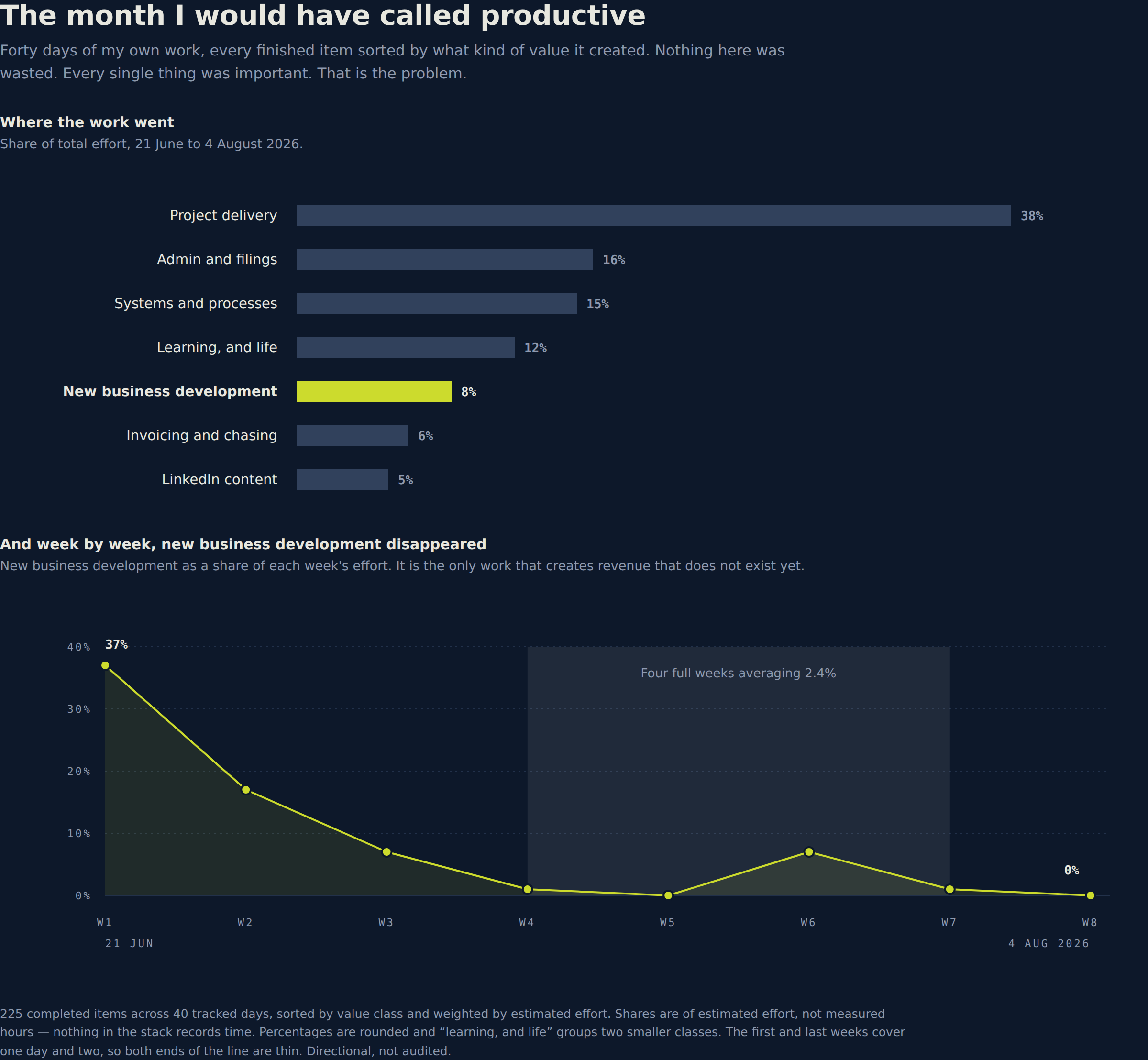
I know how this sounds coming from someone who has told you to focus. So here are my own numbers.
Build From Zero, every second week.
Marketing and growth, for anyone building a business and a brand.
Earlier this year I classified forty days of my own work, two hundred and twenty-five completed items, sorted by what kind of value each one created. Selling, which is the only work that creates revenue that does not exist yet, came to eight per cent of my effort. My own back office, compliance, and building my own systems, was thirty-one per cent. Nearly four times what I spent on selling.
It had not collapsed all at once. In the first week of the window selling was thirty-seven per cent of the work. By the end it was rounding to zero. Nothing in those weeks was wasted. Every item was delivery, or compliance, or a system that genuinely needed building. Every single thing was important.
That is the whole problem. Everything was important, and the one thing that pays the bills quietly went to two per cent while I was busy. If I had not course corrected, I would have delivered the projects I was working on beautifully, only to realise there was no pipeline and I had to start looking for the next project from scratch.
An exclusion list is not a design tool. It is the only defence against a week made entirely of reasonable things.
Five things you can do today
None of this needs a budget or a consultant. Five checks, all free, all done in an evening. Each one ends in something you can rule out, which is the point of the whole issue. Tools move; the questions do not. (Every step checked September 2026.)
Before you run any of them, spend twenty minutes writing your own not-list. Colours, words, the competitors you refuse to be compared to, the customers you are not for, the sentence in a review that would make you wince. Write it badly and write it alone. The five checks below exist to fill that list with evidence, and none of them is much use without it.
Then run them in order. Screenshot each result as you go.
One. Find out how many people are looking for you by name
- Go to search.google.com/search-console and sign in with the Google account that owns your website.
- If your site is not listed, click the property dropdown at the top left, then Add property, then Domain. Type your domain with no https:// and no www. Click Continue. Copy the TXT record it gives you, paste it into the DNS settings at your domain registrar, come back, and click Verify. Data collects from that day forward — there is no history before it.
- In the left menu click Performance, then Search results.
- At the top of the report click + New, then Branded queries.
- Click Branded and write down the clicks. Click Non-branded and write down the clicks.
- If Branded queries is not in that menu, your site does not qualify yet — you need a domain property and a certain volume. Do it by hand instead: + New, then Query, then Queries containing, type your brand name, click Apply.
- Set the date range at the top left to Last 12 months so one quiet fortnight does not mislead you.
Most early brands find that almost nobody searches their name. That is the finding, not a failure.
Rule out every line on your website that assumes the reader already knows who you are. You are renting demand, not owning it.
Two. Find out what Google finishes your sentence with
- Open an incognito window — Ctrl+Shift+N on Windows, Cmd+Shift+N on a Mac. This stops your own search history from flattering you.
- Go to google.com and type your brand name. Do not press enter.
- Screenshot the dropdown. Win+Shift+S on Windows, Cmd+Shift+4 on a Mac.
- Now type each of these and screenshot each dropdown: your brand name followed by vs, then by reviews, then by alternative. Then type is followed by your brand name.
- Do all of it again for your closest competitor.
- Finally, press enter on your brand name and scroll to the People also ask box. Click each question to open it, which loads more.
Autocomplete is the sum of what people actually wonder about you. It is usually a doubt nobody has said to your face.
Rule out the claim your own autocomplete shows people do not believe.
Three. Find the sentence everyone in your category is already using
- Write down the ten companies closest to yours.
- Open each homepage. Copy the main headline and the first paragraph under it. Paste all ten into one document, with the company name above each block.
- Open Claude, ChatGPT or Gemini and paste the whole document in.
- Then type this, exactly: "Below is the homepage headline and opening copy from ten companies in one category. List every claim or promise that appears on five or more of them. Quote their actual words. Do not summarise and do not tell me what makes them different."
- Then ask: "Now list the claims that appear on only one of them."
The first list is the category default — trusted, innovative, customer-first, end-to-end. Ten teams each arrived at it independently, and each thought they were standing out. The second list is where the room to stand is.
Rule out every claim on the first list. That list is now your brief.
Four. Compare their words with yours
- Build one document of real customer language. Your Google reviews — open Google Maps, find your business, click Reviews, then See all. Your app store reviews if you have an app. Your G2 or Capterra page. The last twenty emails in your support inbox. Your notes from the last ten sales calls. Then search Reddit for your category and copy what people say there.
- Aim for fifty to a hundred separate pieces. It does not need to be tidy. Strip out names, email addresses and company identifiers before you paste anything in — you are handing someone else's words to a third party, and you do not need the identifiers for this.
- Paste it into the model and type: "This is what customers say about this category in their own words. List the twenty words and phrases that come up most often, ranked by how often. Use their exact words, not synonyms."
- Now paste your own homepage copy underneath and ask: "Which of those twenty appear in my copy? And which of my words appear nowhere in what customers actually said?"
The second answer is the uncomfortable one. You do not need a brand voice. You need your customers' voice, and they have already written it down for you.
Rule out every word on your site that no customer has ever used.
Five. Compare your share of search with your share of the market
- Go to trends.google.com.
- Type your brand name into the search box and press enter.
- Click + Compare and add up to four competitors, one at a time.
- Set the region to your country and the period to Past 12 months.
- In Interest over time, read the average for each brand.
- Your share of search is your average divided by the total of all five. If you would rather not do the arithmetic, Mangools has a free share-of-search tool that does it for you — a free account, up to five brands at a time.
- Now put that number beside your share of the category's revenue.
Share of search tends to move before market share does, which is why it is worth watching. It breaks on generic names and on brands that sell into several industries, so read it as a direction, not a verdict.
Rule out the marketing plan you were about to approve, if your share of search sits below your share of the market. You are living off distribution rather than brand, and more campaign spend does not fix that.
The short version
One. Stop asking what it should be. Ask what it is not. Colours, words, competitors, customers, the sentence in a review that would make you wince. One sitting, everybody with a veto in the room, out loud. Not a survey, not a circulated document — the value is in people hearing each other reject things.
Two. Write every exclusion down in the words they used, and read it back. This is the step everybody skips. The list is the brief. It is also what stops a settled question reopening in month four, when the person who ruled it out has forgotten they ruled it out.
Three. Do not argue with an exclusion in the room. If someone rules out purple and you think purple is right, let it stand and come back later with actual work and ask for the exception. Turn the session into a debate and people stop offering exclusions, and then you have lost the only thing that was working.
Four. Push until the exclusions contradict each other. When two people you respect rule out opposite things, you have found the real tension in the business. That argument is worth having. The first one was not.
Five. Bring things to be rejected, not a recommendation to be approved. Not one option, and not three with an obvious favourite — people see through that. Bring volume, put it on real surfaces, and let them react. The reactions tighten the list, and the list is what is converging, not the design.
Six. Apply it to your week, not just your brand. Write down what you will not do this quarter and what question you are judging everything against. Mine was whether it pays the bills. Then check yourself against your own record once a month, because the drift is invisible while it is happening.
What I do now
I spent fourteen years building brands and revenue engines for other people. In February 2026 I started building for myself.
Now I run Hyalith. Most relationships start the same way — a forensic look at the whole business: positioning, revenue model, pricing, packaging, sales process, systems and channels. It tells both of us whether anything bigger is worth doing. Often it is not, and I say so.
So run the five checks and send me what you found. Tell me which one surprised you. I read every reply, and the best of them go into the next issue.
Neel
Build From Zero, every second week.
Marketing and growth, for anyone building a business and a brand.